Two weeks in Prague, Vienna and Budapest with my son, Luke.
Wednesday, October 14, 2009

Sunday, August 9, 2009
United Methodist Open Door Ministry: Food
The United Methodist Open Door ministry in Wichita, Kan., provides for the basic needs of food, shelter and clothing for the homeless, near homeless and families living below the poverty level. Families qualify at 130% of the Federal poverty level, which for a family of four is $2,297 a month.
United Methodist Open Door Ministry: Food from Skippy SANCHEZ on Vimeo.
The Open Door commodity program and supplemental food ministry is the largest community-wide food box program in the area, providing nutritionally balanced emergency food assistance once per month for individuals and families in need. The box includes items such as canned fruits and vegetables, meat, eggs, macaroni and cheese, soup, and bread.
The United Methodist Open Door ministry is in the midst of a $7.4 campaign to raise funds for a resource referral center and food distribution center. See umopendoor.org for more information.
Multimedia © 2009 SkippySanchez.com, all rights reserved.
United Methodist Open Door Ministry: Shelter
The United Methodist Open Door ministry in Wichita, Kan., provides for the basic needs of food, shelter and clothing for the homeless, near homeless and families living below the poverty level. Families qualify at 130% of the Federal poverty level, which for a family of four is $2,297 a month.
United Methodist Open Door Ministry: Shelter from Skippy SANCHEZ on Vimeo.
The Transitional Housing program provides housing to homeless families and individuals referred by a local shelter. These participants receive intensive case management and may stay up to two years. The Open Door shelter ministry also provides Safety Net Housing for the mentally ill and a Drop-In Center, the only comprehensive day assistance center for homeless in Wichita, providing case management, a daily meal, access to showers, laundry facilities, small storage, a telephone with message board and mail service.
The United Methodist Open Door ministry is in the midst of a $7.4 campaign to raise funds for a resource referral center and food distribution center. See umopendoor.org for more information.
Multimedia © 2009 SkippySanchez.com, all rights reserved.
United Methodist Open Door Ministry: Clothing
The United Methodist Open Door ministry in Wichita, Kan., provides for the basic needs of food, shelter and clothing for the homeless, near homeless and families living below the poverty level. Families qualify at 130% of the Federal poverty level, which for a family of four is $2,297 a month.
United Methodist Open Door Ministry: Clothing from Skippy SANCHEZ on Vimeo.
The Transitional Housing program provides housing to homeless families and individuals referred by a local shelter. These participants receive intensive case management and may stay up to two years. The Open Door shelter ministry also provides Safety Net Housing for the mentally ill and a Drop-In Center, the only comprehensive day assistance center for homeless in Wichita, providing case management, a daily meal, access to showers, laundry facilities, small storage, a telephone with message board and mail service.
The United Methodist Open Door ministry is in the midst of a $7.4 campaign to raise funds for a resource referral center and food distribution center. See umopendoor.org for more information.
Multimedia © 2009 SkippySanchez.com, all rights reserved.
Thursday, March 5, 2009
Fresh M.I.L.K

I have recently been notified that I am a finalist in the Fresh M.I.L.K competition, a project inspired by the 1950s landmark photographic exhibition, 'The Family of Man.'
My understanding is that, as a finalist, I will be included in the book with 150 other quasi-famous photographers edited by my favorite pal, Elliott Erwitt.
I am most enthusiastic, however, that there are publications seeking positive images that inspire hope. Dictionaries define "hope" as "grounds for believing that something good may happen," or, " a feeling of trust." Traditionally, hope reflects a confidence, not a wish or desire.
Whatever the term means to you, I hope my images convey hope, an
attitude of confidance.
Thursday, December 18, 2008
And now for something completely different...

After nine years of nothing but digital photography, with the exception of a few times I dusted off the MP & loaded a roll of Tri-X, I'm embarking on a new journey down an old path.
Considering the idea for several months, I purchased a used, medium format 6x6mm Kiev88, the inexpensive and famously unpredictable Russian version of a Hasselblad.
Although I am a diehard believer in the quality of digital images over the past several years and certainly am happy enough with my Leica M8s, I find myself being less and less deliberate when I choose to make an image. Even though I keep my cameras set on single frame and rarely use the "continuous" mode, I think less about each individual exposure than when I had to change film every 36 frames and process a batch at the end of the day.
I have been shooting professionally for 28 years, so even after nine years using digital cameras with unbelievable automatic functions, still, almost two thirds of my work has been with film. As mentioned in a previous journal, the very convenience of so much work being done by the camera has become a creative dilemma. Or at least a bugaboo that I need to address.
I have judged several photography contests recently; professional, amateur, high school and college. I have become convinced that auto exposure and auto focus functions on cameras has leveled the playing field in that almost all entries are technically, at least, equal.
Now an image is judged solely on its content and the creativity & skill of the photographer, and that is a good thing, whereas in the olden days a judge could toss at least 60% because the technical quality was crap, regardless of the content. And that was a good thing, too, because technical skill was as much about photography as creativity.
However, be it for good, bad or otherwise, manual focus and manual exposure are skills that are no longer necessary. These skills used to separate the wheat from the chaff, especially when photographing in difficult, tense or dangerous situations.
Be that as it may, I am not one to bemoan the disappearance of these skills any more than I bemoan not having to clean my eight-track tape player or LP records and turntable stylus with special cleaners and little brushes. Cruise control may have made me a lazy driver, but not necessarily a worse driver. But it hasn't made me a better driver, either.
If people never learn to use their cameras on anything but full auto, that's OK by me. A good image has little to do with the camera itself, anyway.
But as for me, I don't want to get any more lazy than I already am. I use calculators and spell check for even the most simple challenges.
I used to take pride in being able to read available light without a meter, choose my f-stop/shutter speed combination without a second thought and manually focus on damn near anything as it moved in damn near any direction.
So now I've got this Kiev. It has a waist-level finder because I like the look of an image made four feet off the ground. I'm looking forward to composing in a square format where horizontal or vertical has more to do with content than with how I orient the camera.
Nearly all my personal work has been of the street variety with a small rangefinder: candid shots, hip shots, wide shots. But there's no concealing this monster under my jacket. The shutter sounds like someone dropped a frying pan on the floor.
I will have to be very deliberate when I take a picture. Especially since each frame will cost about one dollar, counting film and processing.
I can tell you one thing: this ain't the kind of camera I would ever want to use for street photography.
(It will be a LONG time before I even consider setting up a darkroom again.)
Anyway, I'm looking forward to it. I'll let you know how it goes, or you'll see it on eBay in a few months.

Sunday, December 7, 2008
Peregrinaciones de Virgen de Guadalupe
FEAST DAY OF THE VIRGIN OF GUADALUPE
 |
| From Blogger Pictures |
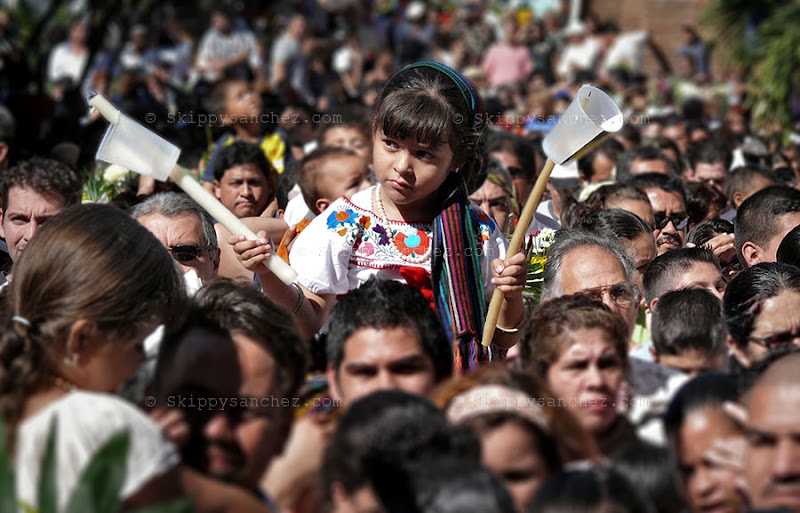
The celebration of Our Lady of Guadalupe (Virgen de Guadalupe), with its colorful religious processions (Peregrinaciones) from December 1-12, is the most public and extended religious holiday in Mexico. Guadlupe is the patron saint of both Puerto Vallarta and of Mexico. She is also known as La Virgen Morena (the brown-skinned virgin). She is believed to be the manifestation of the Virgin Mary in the Americas.
Monday, September 29, 2008
Women are Beautiful (With apologies to Garry Winnogrand)
Click title ^above^ for audio slide show


Recent street & public places snaps....
Friday, July 11, 2008
A New Time for Mexico
A street vendor competes with an international ice cream chain for business...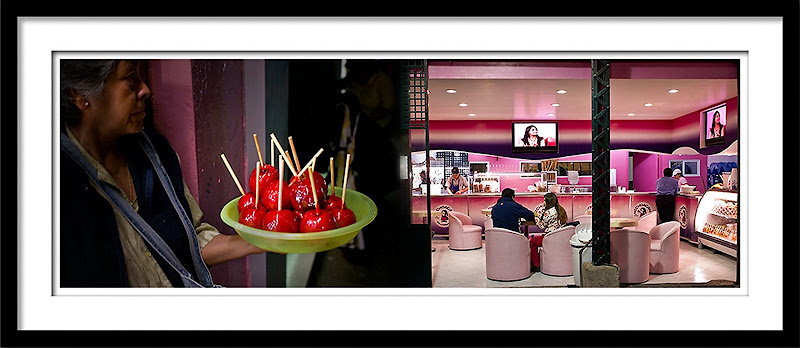
Although many United States citizens bemoan having to "press one for English," and trumpet the risks that our country is becoming Mexican-ized, I believe the opposite is true: Latinos in general and Mexicans in particular are influenced by gringo culture at a far greater pace. Mexicans are more likely to listen to U.S. rock and roll music than gringos are to listen to rancheras. Mexicans are more likely to wear T-shirts with English logos and insipid catch phrases than gringos are to don campesino clothing, mariachi pants or hats the size of hot tubs. Although that would be cool.
Subscribe to:
Posts (Atom)